Home Product Pilot Program Pricing Get in Touch Book Demo
Product Overview

DR1

Decision Referee

Decision support in Slack for teams making real company tradeoffs. Initial setup takes about 2–3 minutes, each decision takes about 30 seconds to 5 minutes depending on depth, and the analysis can use workspace-private firm context enriched from company website content and Brønnøysund Register Centre data where available. Built to be more grounded than a one-off generic AI answer, without pretending to replace judgement.

Pick a depth. Get an answer.

Not every decision needs the same level of scrutiny. All three commands run inside Slack and sit on top of the same workspace-private firm profile. The difference is how much structure, explanation, and challenge the team wants before making the call.

/decide_simple ~30 sec
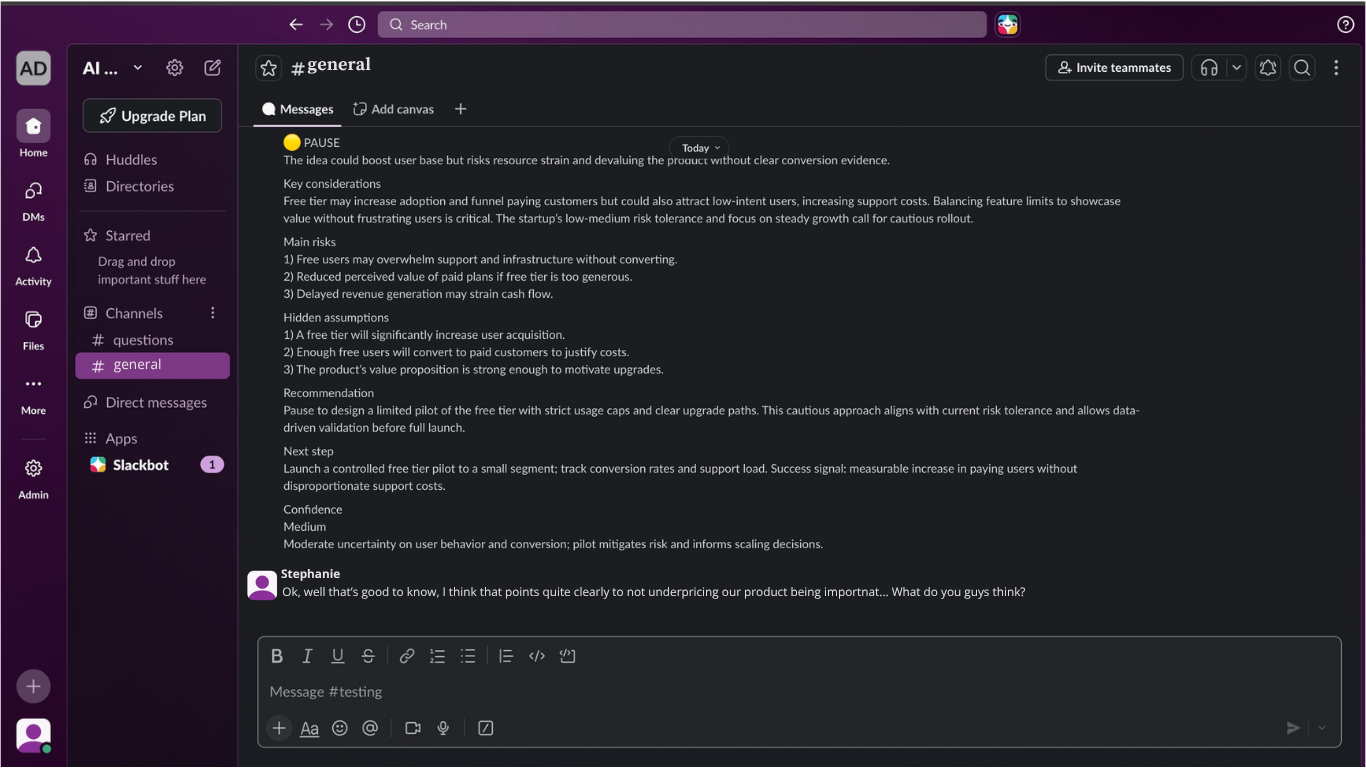
Quick sanity check
For everyday calls that need a fast second opinion. It uses the thread and any firm context already available to return a compact structured output without slowing the discussion down.
Output includes
Decision signal Key consideration(s) Main risk(s) Recommendation Next step Confidence
/decide_simple screenshot
/decide ~2 min
Standard analysis
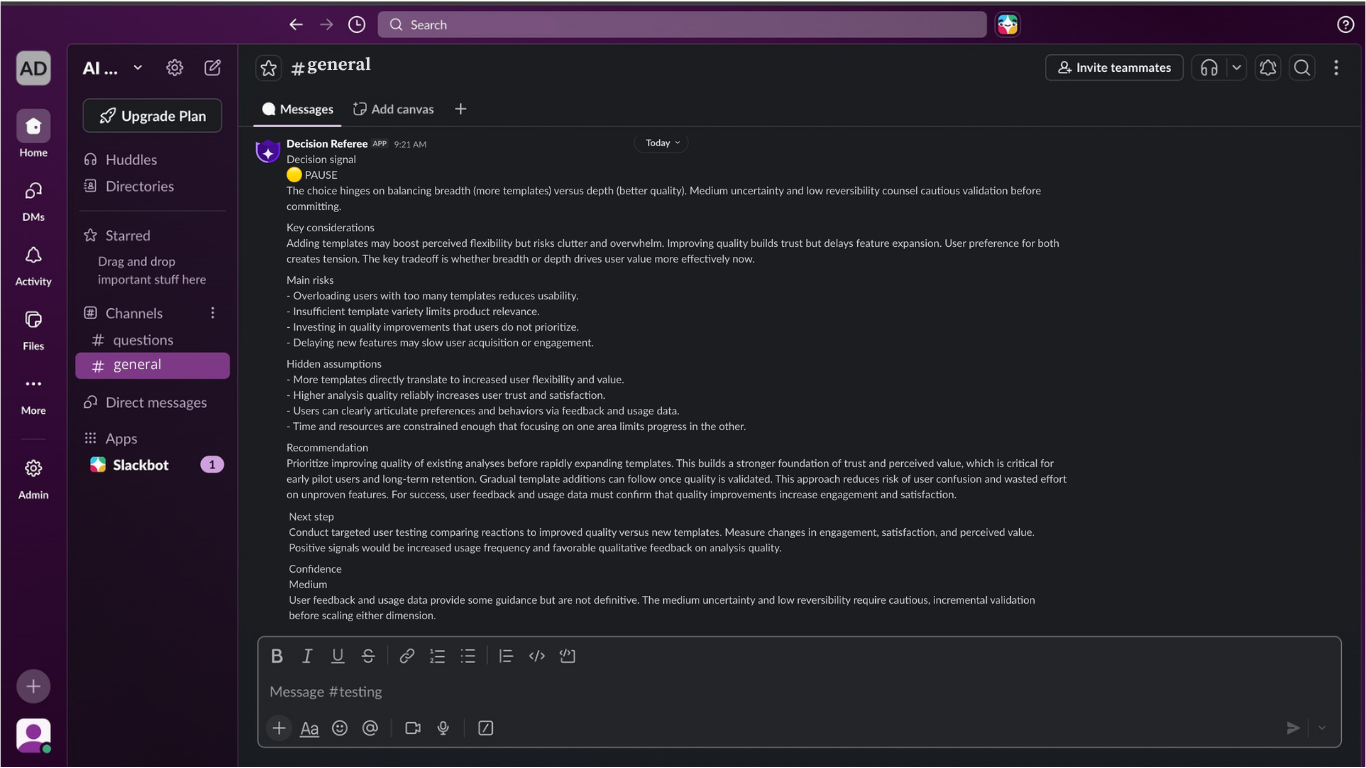
For meaningful decisions that deserve more context. The team adds the decision details in Slack, and Decision Referee combines that with stored firm context to surface key considerations, risks, a recommendation, and a concrete next step.
Output includes
Decision signal Key consideration(s) Main risk(s) Recommendation Next step Confidence
/decide screenshot
/decide_deep ~5 min
Deep evaluation
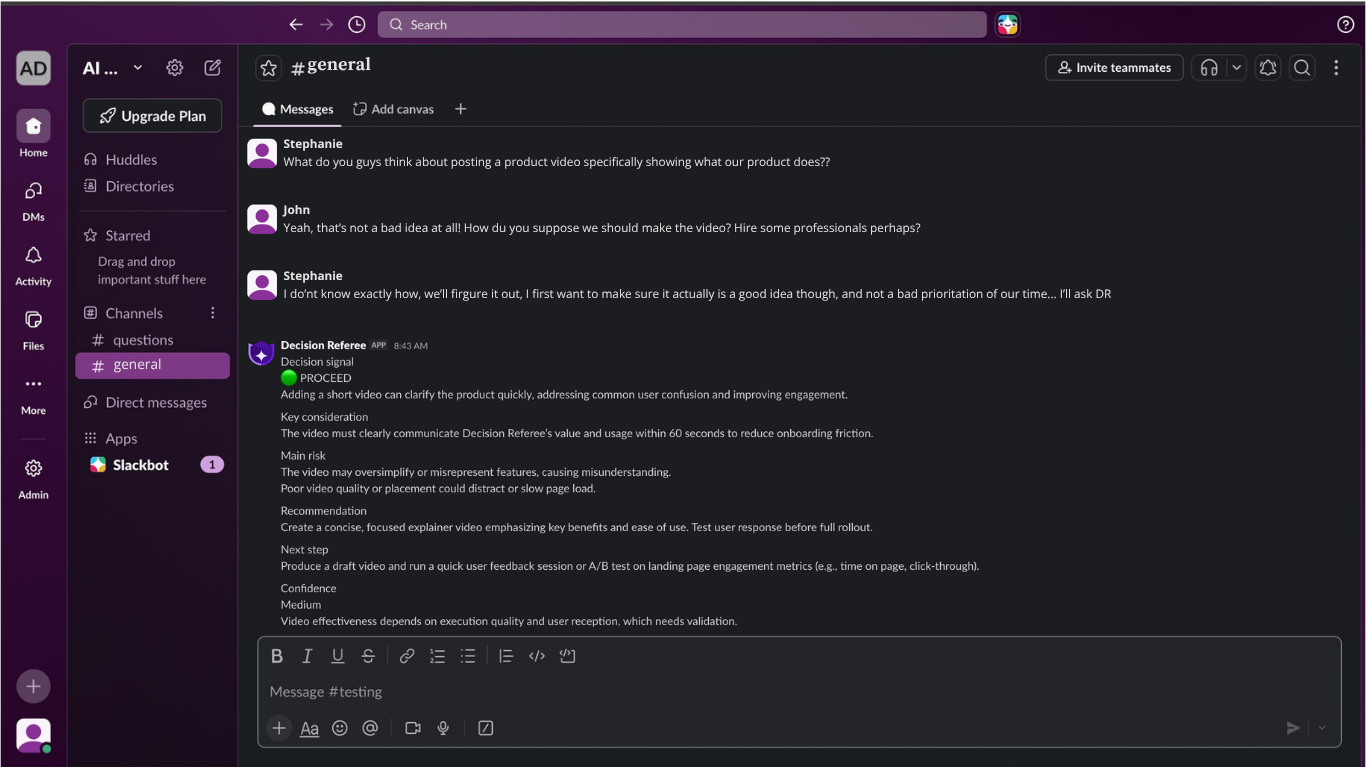
For higher-stakes decisions where you need to slow down. The team walks through assumptions, stakeholders, and alternatives, and Decision Referee uses the same context layer to challenge the reasoning more thoroughly before a commitment is made.
Output includes
Decision signal Key consideration(s) Main risk(s) Deep dive fields Hidden assumptions Recommendation Next step Confidence
/decide_deep screenshot
Three signals. One clear answer.

Every analysis ends with a signal. The point is not false certainty. It is a clear directional recommendation based on the decision input, the stored firm context, and the risks highlighted in the review.

GO

The decision appears reasonably aligned with current goals and manageable risk. Proceed, but with normal caution.

PAUSE

Moderate concerns or missing information. Consider addressing the flagged issues before committing.

STOP

Meaningful red flags were found. Review the analysis carefully and reconsider or restructure the decision.

What you get back.

Every analysis follows the same core structure. The deeper commands ask for more input, but the output format stays consistent so teams can scan it quickly in Slack.

Decision signal

Go, Pause, or Stop. A clear directional recommendation based on the analysis.

Key consideration(s)

The main factors that should shape the decision before the team commits.

Main risk(s)

The most important risks to watch, even if the overall signal is positive.

Hidden assumptions

The assumptions that could change the answer if they turn out to be wrong.

Deep only

Recommendation

The clearest recommended direction based on the available information.

Next step

A concrete action the team should take next so the decision leads to clear follow-through.

Confidence

A stated confidence level in the recommendation based on the information available.

Your context shapes every analysis.

Decision Referee can use a workspace-private firm profile so the analysis is less generic than a one-off prompt. Setup usually takes about 2–3 minutes, starts in Slack with /firm_profile "Org. number" "domain/website", and can be expanded over time as the team adds more context.

01

Strategic fields

Team-maintained priorities, goals, constraints, and risk posture

02

Slack-managed profile flow

Context is created and edited in Slack rather than hidden in a separate admin tool

03

Company website enrichment

Company website content can be used to add business context automatically

04

Brønnøysund enrichment

For Norwegian companies, Brønnøysund Register Centre data can add basic company context automatically

05

Reusable context

Future analyses can reuse the firm context instead of starting from zero, improving relevance over time

06

Current, not permanent

The team can revise the context as strategy, constraints, or focus change

07

Less generic analysis

The aim is a better-grounded review, not a claim of complete company understanding

08

Decision support only

The context layer helps framing, but final responsibility stays with the team

09

Professional boundaries

It is not legal, financial, compliance, or other specialist advice

How firm context is built.

The point of the firm profile is simple: give the analysis more business reality than a generic prompt can provide. The profile is private to each workspace. Decision Referee can enrich it automatically with Brønnøysund Register Centre data and company website content, and that context helps improve decision relevance over time.

01

Strategic fields in Slack

The core profile can include goals, constraints, strategy, time horizon, and risk tolerance. These fields are optional but useful, and they are maintained by the team in Slack so they can change as the business changes.

02

Start with one Slack command

The first firm profile can be created in Slack with /firm_profile "Org. number" "domain/website". Setup usually takes about 2–3 minutes. That gives the product a starting point before any optional strategic fields are added.

03

Automatic enrichment

Decision Referee can enrich the workspace profile with company website content and, for Norwegian companies, Brønnøysund Register Centre data. That helps fill in basic context and improve output quality, but it does not replace internal knowledge from the team.

Track what happened.

Every decision can be followed up. Use /outcome to log what actually happened so the team builds a real record instead of relying on memory or hindsight.

01

Run analysis

Use any command to get a structured assessment of your decision.

02

Make the call

Decide whether to proceed, adjust, or abandon based on the analysis.

03

Log outcome

When you know the result, use /outcome to record what happened.

04

Learn from patterns

Over time, review which signals the team tends to follow, override, or ignore.

Weekly decision health reports.

Every week, the team gets a summary of decision activity: how many decisions were logged, what signals were given, which outcomes were recorded, and where patterns may be worth reviewing.

Weekly Decision Health

Nevorth AS
Mar 11-17, 2026

8 / 12

Outcomes logged

12

Decisions made

4

Stop signals

2

Bias flags

Expand to Swedish market in Q2 Strategic Pending
Switch from Stripe to Adyen Operational Overridden → Negative
Hire senior engineer #3 People Positive
Nothing disappears.

Every analysis is stored the moment it runs. The input, the output, the signal, and the outcome if you logged one. It does not vanish into a Slack thread from three weeks ago.

A

Contextual history

Past decisions remain available as context for the team. That makes it easier to review similar tradeoffs over time instead of rediscovering the same history in scattered threads.

B

Signal accuracy over time

You start to see which kinds of decisions the team gets right and where it tends to override the signal. That track record is useful for calibration, especially as teams grow.

C

Shared decision log

One place for what was decided, why, and what happened. New hires can read the history. Quarterly reviews have a foundation to work from.

Better input, better output.

The analysis is only as sharp as what you feed it. Vague input produces vague recommendations. Ten extra seconds of specificity in the description field changes the quality of everything that comes back.

Vague

Title: New market
Description: Should we expand?
Goal: Growth

Specific

Title: Enter Swedish B2B SaaS market Q2 2026
Description: Three inbound leads from Stockholm in the last month. Product already supports English. Swedish localization is roughly two weeks of work. No local presence yet, considering remote-first GTM with a partner.
Goal: Validate Nordic expansion thesis before committing to a local hire

Vague deep dive

Key risks: Might not work
Assumptions: That it will work
Stakeholders: Team

Specific deep dive

Key risks: No brand recognition in Sweden, unclear data processing regulations, 50K NOK validation budget
Assumptions: Swedish B2B procurement cycles are similar to Norwegian ones. English-first product is acceptable.
Stakeholders: CTO (localization scope), Head of Sales (pipeline capacity), Board (expansion budget sign-off)